



A new EV can be easy to live with when charging fits your daily routine. This EV charger guide explains what homeowners should know before installing a charging station in the garage, driveway, or carport – from choosing the right charging level to checking whether your electrical panel is ready.
For most drivers, home charging is the difference between planning every trip around public stations and starting each morning with a useful range. The right setup depends on your vehicle, driving habits, parking location, and available electrical capacity. A qualified electrician can assess those details before any equipment is purchased or installed.
Start With Your Daily Driving Needs
Before comparing chargers, consider how many miles you typically drive in a day. A household that drives 20 to 40 miles daily has different needs than one with a long commute, multiple EVs, or frequent business travel. You do not always need the highest-powered charger available.
Also consider when the vehicle is parked. If it sits at home overnight for eight to 12 hours, even moderate charging speed can replenish a typical day of driving. If drivers need quick turnaround between trips, higher-capacity Level 2 charging may make better sense.
The vehicle itself matters too. Check its charging port, maximum AC charging rate, and manufacturer recommendations. Some vehicles can accept more power than others. Installing a larger circuit than the car can use may help with a future vehicle, but it will not make the current vehicle charge faster than its onboard equipment allows.
Level 1 vs. Level 2 Charging
Level 1 charging uses a standard outlet
Level 1 charging generally uses a standard 120-volt household receptacle and the portable charging cord that comes with many EVs. It is the simplest option because it may not require a new charging station.
The trade-off is speed. Level 1 often adds roughly 3 to 5 miles of range per hour, though results vary by vehicle and conditions. It can work well for plug-in hybrids, low-mileage drivers, or households that have plenty of time between drives.
A standard outlet should not automatically be assumed safe for continuous EV charging. Older, worn, loose, or improperly wired receptacles can overheat under a sustained load. An electrician can inspect the circuit, outlet condition, grounding, and breaker size to determine whether it is suitable.
Level 2 charging is the common home upgrade
Level 2 charging uses a 240-volt circuit, similar to the type used for major appliances. Depending on the charger, circuit size, vehicle, and settings, it can often add about 20 to 40 miles of range per hour. For many homeowners, this is the practical choice for overnight charging.
A Level 2 unit can be hardwired directly to the electrical system or plugged into a properly installed 240-volt outlet. Hardwired installations are often a clean, durable option, especially for outdoor locations or higher-power equipment. Plug-in units offer flexibility if you may replace the charger later, but the outlet and cord must be rated and installed correctly for the continuous load.
Level 2 does require more planning. The installation may involve a dedicated circuit, conduit, a new breaker, wiring through attic or wall spaces, and possibly an electrical panel upgrade. That is why a site assessment should come before choosing equipment based on price alone.
Choose the Right Charger Location
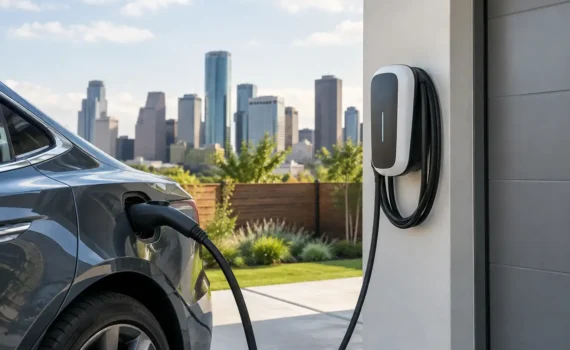
The best charging location is usually the place where your vehicle parks most often. In many Houston-area homes, that is inside the garage. A wall-mounted charger near the vehicle’s charge port can keep the cable off the floor and reduce clutter around doors, walkways, and storage areas.
Measure before installation. Charging cables have different lengths, and the charge port may be on the front, rear, or side of the vehicle. The cable should reach comfortably without being stretched, pinched, or routed across a path where people walk.
Driveway and carport installations are also possible when equipment is rated for outdoor use. Outdoor charging equipment should be installed where it is protected from physical damage when practical and positioned to limit exposure to standing water, sprinkler spray, and vehicle impact. The wiring method, weatherproof enclosure, and mounting hardware all matter.
For a detached garage, the distance from the main electrical panel can affect cost. A longer wire run may require trenching, conduit, larger conductors, or a subpanel. It is still a worthwhile improvement for many properties, but it should be priced based on the actual site conditions.
Make Sure Your Electrical System Can Support It
An EV charger is a sustained electrical load, not just another device that runs for a few minutes. The circuit must be properly sized, and the home needs sufficient available capacity to support it along with air conditioning, electric cooking, pool equipment, dryers, and other major loads.
A professional load calculation helps determine whether your current panel can handle the new circuit. A 200-amp panel often has room for an EV charger, but the panel rating alone does not answer the question. A home with several large electric appliances may already be using much of its available capacity. Conversely, some smaller homes can support charging with the right equipment and load management approach.
If the panel is full, an electrician may be able to reorganize circuits, add a subpanel, install tandem breakers where appropriate, or recommend a panel upgrade. The right solution depends on the panel’s condition, capacity, manufacturer, and local code requirements. Forcing an oversized breaker into an existing system is never an acceptable shortcut.
Understand the 80 percent rule
EV charging is generally treated as a continuous load because it can run for several hours. In simple terms, the circuit must be sized above the charger’s continuous output. For example, a charger set to deliver 32 amps typically requires a 40-amp circuit. A charger delivering 40 amps typically requires a 50-amp circuit.
This is one reason settings matter. Many Level 2 chargers allow the output to be adjusted. A lower setting may be the sensible choice when a home has limited capacity, when charging overnight is sufficient, or when avoiding a larger electrical upgrade keeps the project practical.
Features Worth Paying For
Not every home needs a feature-packed smart charger. Reliable charging, proper installation, and a correctly sized circuit matter more than a long app menu. Still, a few features can be useful depending on the household.
Scheduling can help drivers charge during lower utility-rate periods if their electric plan offers time-based pricing. Usage tracking can be helpful for homeowners who want to monitor electricity costs or businesses that reimburse employee charging. Wi-Fi connectivity may offer remote status updates, but it also adds another device that depends on a stable network and software support.
For homes with two EVs, look at chargers with load sharing or coordinated scheduling. Some systems can divide available power between two vehicles instead of requiring two full-capacity circuits. This can reduce the need for a major service upgrade, although it may mean each vehicle charges more slowly when both are connected.
Tesla owners have an additional choice between a Tesla Wall Connector and a compatible universal charger. Other EVs may use different connector standards, so select equipment that works with the vehicles you own and any vehicles you reasonably expect to own next.
Permits, Safety, and Professional Installation
EV charger installation is electrical work that should be completed to applicable code and permit requirements. Permits and inspections are designed to verify safe circuit sizing, proper grounding, approved wiring methods, weather protection, and equipment installation. Requirements can vary by city and jurisdiction.
Do not rely on an extension cord for routine EV charging, and do not use an outlet that feels loose, becomes warm, or shows discoloration. Those are warning signs that should be checked promptly. The same applies to breakers that trip while charging or lights that flicker when the vehicle begins drawing power.
A professional installation should leave you with a clean work area, clear information about the circuit and charger settings, and a setup that is easy to use every day. Beekman Electric provides free estimates for EV and Tesla charger installation, including an on-site look at panel capacity, equipment location, and the scope of work needed.
A Better Charge Starts With the Right Plan
The most useful charger is not always the biggest one. It is the one that safely supports how you drive, fits your parking area, and works with your home’s electrical system without creating unnecessary expense. Before buying equipment, schedule an assessment so the installation is planned correctly from the panel to the parking spot.