



A new EV can plug into a standard household outlet, but that does not automatically make it the best way to charge at home. When comparing an EV charger vs wall outlet, the practical questions are how far you drive, how long your vehicle sits overnight, and whether your home’s electrical system can safely support the load.
For many Houston-area homeowners, a standard outlet works as a temporary starting point. A professionally installed Level 2 charging station is usually the better long-term answer for faster, more dependable daily charging.
EV Charger vs Wall Outlet: The Day-to-Day Difference
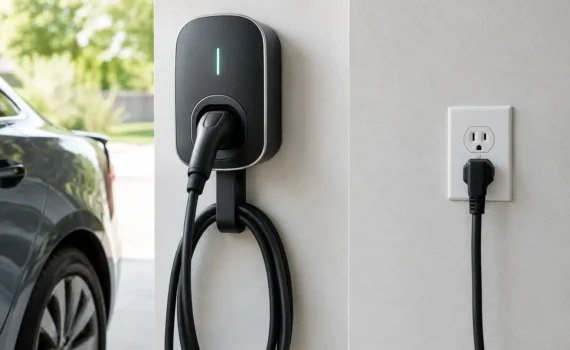
A standard wall outlet provides 120-volt power. This is commonly called Level 1 charging. Most EVs include a portable charging cord that can plug into a properly grounded household outlet, allowing you to add charge slowly while the vehicle is parked.
A dedicated EV charging station typically uses 240-volt power, also called Level 2 charging. It is installed on its own circuit and can deliver substantially more power to the vehicle. The charging equipment communicates with the car and delivers only the amount of power the vehicle and circuit are designed to handle.
One detail often causes confusion: the wall-mounted unit is technically called EV supply equipment, while the car contains the actual battery charger. In everyday conversation, though, most people call the wall-mounted equipment an EV charger. The name matters less than choosing equipment, wiring, and circuit protection that are properly matched.
Charging Speed Is the Biggest Difference
Level 1 charging from a 120-volt outlet commonly adds about 3 to 5 miles of driving range per hour. That can be enough for a plug-in hybrid or a driver with a short commute and plenty of overnight parking time. If you drive 25 to 35 miles most days, you may be able to recover that distance overnight.
The math changes quickly for a fully electric vehicle with a longer daily commute. Recharging a low battery through a regular outlet can take more than a full day. If you arrive home late, leave early, or make extra trips during the week, the vehicle may not gain enough range to keep up.
A Level 2 charger can often add roughly 12 to 40 miles of range per hour, depending on the charger, vehicle, and electrical circuit. That means many drivers can replenish their normal daily use overnight instead of planning around a slow charge. It also gives households more flexibility when two drivers share one EV or when weekend driving is heavier than usual.
Is a Regular Outlet Safe for EV Charging?
A standard outlet can be safe when the outlet, wiring, and circuit are in good condition and the vehicle manufacturer permits that charging method. But EV charging is different from briefly plugging in a lamp or phone charger. It can place a high, continuous electrical load on the circuit for many hours.
Older outlets can become loose over time. Worn contacts, damaged wiring, improperly installed receptacles, or overloaded circuits can create heat at the connection point. A receptacle that feels hot, looks discolored, smells burnt, trips a breaker, or intermittently stops charging needs prompt attention from a licensed electrician.
It is also wise to consider what else is on the circuit. A garage outlet may share power with a refrigerator, freezer, tools, garage door opener, or outdoor receptacles. That arrangement may be inconvenient at best and unsuitable for sustained EV charging at worst. Extension cords are not a good solution for routine vehicle charging because they can overheat, become damaged, or create a trip hazard.
A dedicated Level 2 circuit is designed around the charger’s expected load. The electrician evaluates the circuit breaker, wire size, charging equipment rating, location, and connection method. In many installations, hardwiring the charging equipment is a clean, durable option that avoids the wear associated with repeatedly plugging and unplugging a high-load device.
Your Electrical Panel Matters
Installing a charger is not simply a matter of adding a receptacle in the garage. The home’s electrical panel must have enough capacity for the new continuous load. That is especially relevant in homes that already have major electrical demands such as electric ranges, pool equipment, air conditioning, electric dryers, hot tubs, or workshop equipment.
A qualified electrician performs a load calculation and checks the panel condition before recommending a charger size. Some homes have room for a new EV circuit with no major changes. Others may need a panel upgrade, a subpanel, or a lower-amperage charger that still provides plenty of overnight charging.
This is not a place to guess based on an open breaker space. A panel can have physical room for another breaker without having sufficient electrical capacity for the added load. A professional evaluation helps avoid nuisance tripping, equipment limitations, and costly changes after installation begins.
What Does an EV Charger Installation Cost?
The cost of a Level 2 installation depends more on the home than the charger itself. A charger mounted near the electrical panel with a straightforward wire route is generally less involved than one installed across the home, in a detached garage, or at the end of a long outdoor run.
Other factors include the desired charging amperage, panel capacity, permit requirements, wall access, trenching, and whether the installation calls for a receptacle or hardwired equipment. If a panel upgrade is needed, that becomes a larger electrical project, but it can also improve capacity for future appliances or home improvements.
Using an existing dryer outlet may sound like a shortcut, but it is not always the right answer. Outlet types, circuit ratings, wiring condition, load-sharing needs, and charger requirements all need to be verified. A dedicated circuit is usually the clearest and most reliable approach for regular EV charging.
Which Option Fits Your Driving Habits?
A wall outlet may be enough if you drive a plug-in hybrid, travel short distances, have predictable overnight parking, and are comfortable with slow charging. It can also work as a backup option for travel or temporary use, provided the outlet and circuit are suitable.
A Level 2 charger makes more sense when you drive a fully electric vehicle daily, need to recover range quickly, expect a second EV in the future, or want charging to be as simple as parking and plugging in. Faster home charging can reduce dependence on public charging stations and make ownership more convenient.
The right charger does not always have to be the highest-amperage model. A properly sized 240-volt charger can be an excellent fit when it meets your overnight charging needs without forcing an unnecessary panel upgrade. The best installation is one that matches your vehicle, household usage, and long-term plans.
Plan the Installation Before You Buy Equipment
Before purchasing a charging unit, confirm the vehicle’s maximum Level 2 charging rate and decide where the charge port will sit when the vehicle is parked. Charger placement affects cord reach, wall mounting, weather exposure, and whether the cable can be stored neatly without crossing a walkway.
For outdoor installations, use equipment rated for the location and ensure the wiring method is appropriate for the environment. In a garage, a clean installation keeps the charger accessible while protecting it from impact, moisture, and clutter. Local permitting and inspection requirements may apply, and they are part of doing the work correctly.
Beekman Electric can assess your panel, review charger location options, and provide a clear estimate for a code-conscious EV charger installation. A quick professional assessment gives you a better answer than relying on a charger box label or a neighbor’s setup.
A Better Way to Think About Home Charging
A standard outlet is useful when slow charging genuinely fits your routine. A dedicated Level 2 charger is an investment in convenience, capacity, and confidence as EV use becomes part of everyday life. If your current outlet runs warm, your charge time never catches up, or you are planning for a new vehicle, it is a good time to have the electrical side evaluated before the first frustrating charging week.