



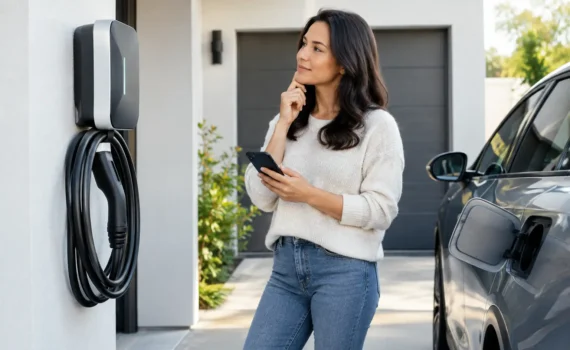
A new EV can change the way you think about fueling up. Instead of stopping at a gas station, you may start each morning with a full battery in the garage. But before buying equipment, homeowners often ask what size EV charger is needed for their home. The right answer depends less on the size of the battery and more on how far you drive, how long the vehicle is parked, your EV’s charging limit, and what your electrical panel can safely support.
For many Katy and West Houston homeowners, a properly installed 240-volt Level 2 charger is the practical choice. That does not automatically mean you need the largest charger available. A charger that fits your daily routine and electrical capacity is usually the better investment.
Start With Your Daily Driving and Overnight Time
Think about the miles you need to replace on a typical day. If you commute 30 to 50 miles and your vehicle sits in the garage for eight to 10 hours overnight, you do not need an exceptionally high-powered charger to wake up ready for the next day.
Level 1 charging uses a standard 120-volt outlet. It commonly adds about 3 to 5 miles of range per hour. For a plug-in hybrid or a vehicle driven lightly, that may be enough. For a fully electric vehicle with a regular commute, Level 1 can feel slow. Recovering 40 miles of driving may take an entire night or longer.
Level 2 charging uses a 240-volt circuit, similar to the power used by a dryer, range, or some HVAC equipment. Depending on the circuit and charger settings, Level 2 equipment can add roughly 10 to 40 miles of range per hour. That range is wide because vehicle capability, charger amperage, battery condition, and temperature all affect the result.
A 32-amp Level 2 charger is often enough for a household with one EV and normal overnight charging. A 40-amp or 48-amp charger can make sense when you drive more miles, have less time between trips, or expect to add another EV later.
What Size EV Charger Is Needed? Understand Amps and Circuits
The number on the charger is not the same as the size of the circuit breaker. EV charging is considered a continuous electrical load because it can run for several hours. Electrical design accounts for that extended demand by sizing the circuit at 125% of the charger’s continuous output.
In plain terms, a 32-amp charger generally needs a dedicated 40-amp circuit. A 40-amp charger generally needs a dedicated 50-amp circuit. A 48-amp charger generally needs a dedicated 60-amp circuit and is commonly hardwired rather than connected to a receptacle.
This is one reason not to select an EV charger based only on the largest amperage listed on the box. Installing a 48-amp unit may require a larger breaker, heavier wire, a panel upgrade, or all three. If your actual needs are modest, a 32-amp or 40-amp unit may provide excellent overnight charging without unnecessary electrical work.
The charger also needs its own dedicated circuit. Sharing a circuit with a dryer, freezer, lighting, or garage outlets is not a safe or code-conscious installation approach.
Your Vehicle May Set the Limit
A home charging station can only provide as much power as both the vehicle and the circuit allow. Every EV has an onboard charger with a maximum Level 2 charging rate. If your vehicle accepts only 32 amps, installing a 48-amp charging station will not make it charge at 48 amps.
Check your owner’s manual or vehicle specifications for the maximum AC charging rate. Tesla vehicles, for example, may have different charging limits depending on model and year. Other EVs may be limited to 16, 32, 40, or 48 amps. The charging station can be larger than the vehicle’s current limit, but the vehicle will only draw what it is designed to accept.
That does not make a higher-capacity installation pointless. A properly sized circuit can provide flexibility if you replace the vehicle later. The key is to weigh future plans against the added cost of larger wire, breakers, equipment, and possible panel work.
Choose Between a Plug-In and Hardwired Charger
Many homeowners like the convenience of a plug-in charging station, often using a 240-volt receptacle. A common example is a 14-50 outlet. This can be a good option when the charger is designed for that connection and the receptacle, wiring, breaker, and installation are correctly rated.
However, a 14-50 receptacle on a 50-amp circuit is typically appropriate for charging equipment that draws up to 40 amps continuously. It is not a shortcut for running a 48-amp charger. Plug-in equipment also places repeated load on the receptacle over time, so material quality and correct installation matter.
Hardwired chargers are permanently connected to the electrical system. They are often preferred for 48-amp charging, outdoor installations, or situations where a cleaner, more durable setup is needed. A hardwired unit can also eliminate a receptacle connection point, although it is less portable if you move or replace equipment.
Make Sure the Electrical Panel Can Handle It
A 200-amp service does not automatically mean there is enough capacity for a 60-amp EV circuit. Likewise, a 100-amp panel does not automatically rule out EV charging. The answer comes from a load calculation that considers the home’s actual electrical demand.
An electrician evaluates major loads such as air conditioning, electric heat, water heaters, ranges, dryers, pool equipment, hot tubs, and existing circuits. This matters in the Houston area, where air conditioning may be running at full demand when your vehicle is charging overnight.
Sometimes the panel has enough capacity and open breaker space for a new EV circuit. In other homes, the best solution may be a panel upgrade, a subpanel, load-management equipment, or a lower-amperage charger. A lower charging rate is not necessarily a compromise if it still restores your daily driving range overnight.
Do Not Overlook Installation Details
The distance from the panel to the parking location affects the job. A charger mounted next to a garage panel is usually simpler than one serving a detached garage, driveway, carport, or parking area on the other side of the home. Longer runs require more wire and may require trenching, conduit, or other protective methods.
The charger location should allow the cable to reach the vehicle’s charge port without stretching across a walkway or driveway. Outdoor equipment needs to be rated for the environment, and the mounting location should protect the unit from physical damage where possible.
Permits and inspections may also apply based on the city or local authority with jurisdiction. These requirements are not paperwork for paperwork’s sake. They help confirm that conductor size, breaker protection, grounding, equipment ratings, and installation methods are appropriate for a high-demand circuit that will operate regularly.
A Practical Sizing Example
Suppose you drive 60 miles on a normal workday and can charge from 9 p.m. to 7 a.m. A 32-amp Level 2 charger can commonly replace far more than 60 miles during that window. Moving to a 48-amp charger may reduce charging time, but it may not materially improve your day-to-day experience.
Now consider a household with two EVs, a long commute, frequent same-day trips, or a vehicle that must be ready again in a few hours. Faster charging may be worth the added electrical capacity. Another option is installing one appropriately sized charger now while planning the panel and conduit layout for a second charger later.
The best charger size is the one that safely fits the vehicle, the home, and the way you actually drive. Before purchasing equipment, have a licensed electrician review the panel, parking location, circuit route, and charging goals. Beekman Electric provides free estimates for EV charger installations throughout Katy and the surrounding West Houston area, so you can make the decision with clear numbers instead of guesswork.