



Owner provided EV chargers installed starting at 499.00. Call for a free estimate. 281-665-2285
A new EV charger, a remodeled kitchen, added office equipment, or a growing commercial load can all expose the same problem: your electrical panel no longer has enough safe, dependable capacity. Panel upgrades give your home or business the room to operate modern electrical equipment without overloading an aging system or relying on a crowded panel full of workarounds.
For property owners in Katy and the greater Houston area, this is not usually a project to put off until a breaker fails. A panel that is too small, outdated, damaged, or full can affect everyday reliability and limit what you can add next. The right answer depends on the condition of the existing electrical system, the load the property requires, and the scope of the work you have planned.
Signs Your Electrical Panel May Be Holding You Back
A breaker that trips occasionally after a clear overload is doing its job. Repeated tripping from normal use is different. If the microwave, air conditioner, computers, lighting, or shop equipment regularly cause circuits to shut down, the system may need evaluation.
Other warning signs deserve prompt attention: breakers that feel hot, a burning smell near the panel, buzzing sounds, corrosion, flickering lights, visible damage, or a panel cover that no longer fits correctly. These conditions do not automatically mean a full replacement is required, but they do call for a licensed electrician to inspect the system. Do not keep resetting a breaker that will not stay on or try to solve the problem by installing a larger breaker yourself. The wiring and equipment must be properly matched and protected.
Capacity is another practical concern. Many older homes were built before central air conditioning, multiple televisions, home offices, induction ranges, hot tubs, EV charging, and smart-home equipment became common. A 100-amp service may be sufficient for some properties, while others need 200 amps or more to safely support their current and planned electrical demand. The number on the panel alone does not tell the whole story. A load calculation and a close look at the existing equipment are necessary.
What Panel Upgrades Can Include
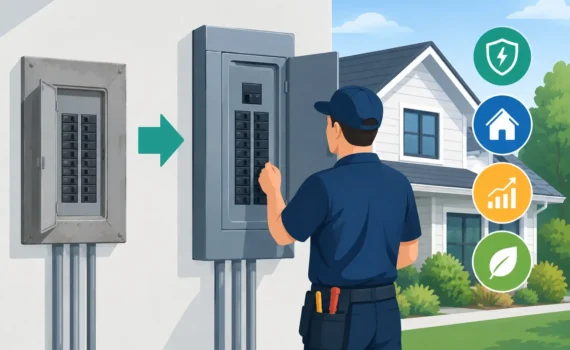
People often use the phrase “panel upgrade” to describe several different types of electrical work. Sometimes the job is a new load center with modern breakers. In other cases, it involves replacing damaged equipment, reorganizing improperly installed circuits, correcting grounding and bonding issues, adding capacity, or upgrading the service equipment that feeds the panel.
For a home, the project may be prompted by a new EV or Tesla charger, a generator inlet box and transfer switch, a major addition, or a kitchen renovation. For a business, it may support new machinery, expanded tenant space, additional circuits, LED lighting upgrades, or equipment that cannot share power with existing loads.
The scope matters because a panel replacement is not always the same as a service upgrade. Replacing an old or defective panel with one of a similar capacity can improve safety and organization. Increasing the electrical service may require work beyond the panel itself, including meter equipment, service conductors, grounding components, utility coordination, and permits. A qualified electrician can explain which level of work fits the property instead of recommending more than the job requires.
Space in the Panel Is Not the Same as Available Capacity
An empty breaker position can be useful, but it does not guarantee the property has capacity for a new major load. Likewise, a panel that looks full may have practical options depending on the equipment and electrical calculation. This is why an estimate should begin with the planned equipment, the existing loads, and the condition of the service – not simply the number of open spaces.
Adding a 240-volt EV charger, for example, is different from adding a bedroom light. The charger may require a dedicated circuit and can place a significant ongoing demand on the system. The same is true for electric heating equipment, pool equipment, commercial refrigeration, and certain shop tools.
When an Upgrade Is Worth the Investment
Panel work makes sense when it solves a real safety, capacity, or reliability issue. It can also be a smart part of a larger project because electrical access is often easier before walls are closed, equipment is installed, or a new business area is occupied.
For homeowners, an upgrade can make future improvements less complicated. It may provide room for dedicated circuits, whole-home surge protection, outdoor equipment, a generator connection, or a charging station. It can also replace an old panel that creates concern for insurance, inspections, or a future sale.
Commercial property owners often benefit from addressing electrical capacity before it turns into downtime. A retail space with nuisance trips, poor lighting performance, or added equipment may lose productivity and customer confidence when power is unreliable. Facility managers also need panels that are clearly labeled, accessible, and capable of supporting repairs without disrupting unrelated areas of the building.
Still, bigger is not automatically better. If the service and panel are in good condition and the load calculation supports the planned circuit, a targeted circuit installation may be the more practical choice. The goal is dependable power sized for the property, not an unnecessary upgrade.
What to Expect During a Professional Panel Upgrade
A proper evaluation starts with a conversation about how the property uses electricity now and what is planned next. An electrician should inspect the existing panel, breakers, service equipment, visible wiring conditions, grounding, and available circuit space. For capacity questions, they should perform or review the load calculation rather than making assumptions based only on the building size.
The estimate should clearly describe the work, including whether it covers a panel replacement, a service capacity increase, new circuits, surge protection, permits, or utility-related coordination. Clear scope helps prevent surprises and gives property owners a better basis for comparing quotes.
During installation, power will usually need to be shut off for part of the job. The duration depends on the condition of the existing equipment and whether service-related work is involved. For businesses, planning the shutdown around operating hours can reduce disruption. For homes, it helps to prepare for a temporary loss of lighting, internet, refrigeration, and air conditioning.
After the work, circuits should be labeled clearly and the work area left clean. Good labeling is more than a finishing touch. When a breaker trips or a future repair is needed, knowing exactly what each circuit serves saves time and reduces guesswork.
Questions to Ask Before Scheduling Panel Work
Before approving an estimate, ask whether the recommendation is a panel replacement, a service upgrade, or both. Ask what capacity is being recommended and why it fits your actual load. If you are planning an EV charger, generator connection, addition, or commercial equipment purchase, bring that up early so it is included in the assessment.
It is also reasonable to ask about permits, inspections, expected outage time, equipment warranty, and how the circuits will be labeled. A professional electrician should answer in plain language and explain any limitations found in the existing system.
Beekman Electric provides FREE estimates for residential and commercial electrical work throughout Katy, Houston, Sugar Land, Cypress, Fulshear, Brookshire, Richmond, Rosenberg, Missouri City, and surrounding communities. With more than 40 years of electrical experience, the team can assess whether your property needs a full panel upgrade, a service upgrade, or a focused solution that addresses the immediate problem.
If your panel is showing warning signs or your next project needs more power, schedule an evaluation before the demand becomes an interruption. A clear estimate and the right electrical plan can keep your property safer, better prepared, and ready for what you need to add next.