



A room goes dark, the garage outlet stops working, or the microwave suddenly shuts off halfway through dinner. Before assuming the appliance has failed, learn how to identify breaker trips. A tripped circuit breaker is designed to cut power when it detects a condition that could overheat wiring, damage equipment, or create a shock or fire risk.
The key is not simply getting the power back on. It is figuring out which circuit lost power, what caused it to trip, and whether resetting it is safe. One trip after too many appliances were running may be straightforward. A breaker that trips again, trips with nothing plugged in, or has signs of heat needs professional attention.
What a Tripped Breaker Looks Like
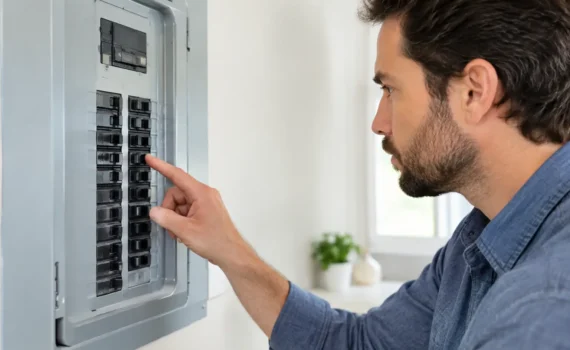
Start at your electrical panel. Most modern breakers have three positions: ON, OFF, and a middle tripped position. A tripped breaker may not look dramatically different from the others. Its handle often rests slightly between ON and OFF, rather than lining up fully with either position.
Panels vary, so look closely. On some models, the handle moves only a small amount when it trips. Others show a colored indicator or a visible trip flag. Compare the handle position with nearby breakers that are still operating normally. The breaker serving the affected area may be slightly out of line.
A breaker cannot usually be reset by pushing it directly toward ON. Move it firmly all the way to OFF first, then move it back to ON. If it stays on, power may return to the circuit. If it immediately moves back to the tripped position, stop trying to reset it.
Do not remove the panel cover or touch wiring inside the panel. The breaker handles are intended for normal operation. The wiring and connections behind the cover are not a homeowner repair area.
How to Identify Breaker Trips Instead of Other Power Problems
Not every loss of power comes from a breaker trip. Narrowing down the symptoms helps prevent wasted time and points toward the right repair.
If only one room, group of outlets, or a single major appliance has lost power, a branch-circuit breaker is a likely cause. Check the panel and see whether one breaker is in the tripped position. Panel labels can help, but labels are not always accurate in older homes or after remodeling work.
If several areas of the home are out, check whether a larger main breaker has tripped. A main breaker is usually larger than the branch breakers and may be located at the top, bottom, or separate section of the panel. If your neighbors also have no power, the issue may be a utility outage rather than your electrical system.
An outlet can also lose power because a GFCI outlet tripped. These outlets have TEST and RESET buttons and are commonly found in bathrooms, kitchens, garages, laundry rooms, exterior locations, and unfinished areas. One GFCI outlet can protect other outlets downstream, so the dead outlet may not be the one with the reset button. Check nearby GFCI outlets before assuming a breaker has failed.
For a split system, such as an air conditioner, electric range, dryer, or EV charger, look for a double-pole breaker with two handles tied together. If either side trips, both sides should switch off. Because these circuits carry higher voltage and serve major equipment, repeated trips call for an electrician rather than repeated resets.
Common Clues That Explain the Trip
A breaker trips for a reason. Pay attention to what happened immediately before the power went out. That detail gives an electrician useful information and may reveal an overload you can avoid.
An overload occurs when a circuit is asked to supply more power than it is designed to handle. Space heaters, hair dryers, air fryers, microwaves, portable air conditioners, and power tools can draw substantial power. Running several of them on the same circuit can trip the breaker, especially in older homes where multiple rooms may share one circuit.
A short circuit is different. It happens when electricity takes an unintended path, often because of damaged wiring, a faulty outlet, a loose connection, or an appliance problem. Short circuits may cause a breaker to trip instantly when you turn on a switch or plug in a certain item.
Ground faults occur when electricity flows where it should not, including through a grounded surface or moisture-damaged component. GFCI protection is designed to react quickly to these conditions. A damp outdoor outlet, damaged extension cord, faulty disposal, or worn appliance can be involved.
Arc faults are another concern. An arc fault can result from damaged conductors, loose connections, or worn cords that allow electricity to jump across a gap. Many newer homes use AFCI breakers to detect these dangerous arcing conditions. These breakers can trip for legitimate hazards, but certain older appliances or wiring issues may require diagnosis to determine the cause.
A Safe Way to Check the Circuit
If there is no burning smell, buzzing, visible damage, or heat at the panel, you can make one careful reset attempt. First, turn off or unplug the items that were operating when the circuit tripped. This reduces the chance of immediately recreating an overload.
Then reset the breaker by moving it fully to OFF and then back to ON. Return to the affected area and see what has power. If the circuit remains on, plug items back in one at a time. If the breaker trips when a particular appliance, cord, or tool is connected, leave that item unplugged. The appliance may need service or replacement.
If the breaker trips when you turn on a particular light switch, use a specific outlet, or operate a built-in appliance, do not continue testing. The issue could be in the fixture, outlet, switch, appliance wiring, or circuit itself.
Avoid using extension cords as a permanent workaround for a dead circuit. They can create an overload or conceal an electrical problem that should be repaired. Likewise, never replace a breaker with a larger one to stop nuisance trips. Breaker size is matched to the wire size and circuit design. Increasing it without correcting the wiring can create a serious overheating hazard.
When a Breaker Trip Requires an Electrician
A single overload trip may be a useful warning that too much was running at once. Repeated trips are not normal. Call a licensed electrician if the breaker will not reset, trips immediately after reset, or trips repeatedly over days or weeks.
You should also stop using the circuit and arrange service if you notice a burning odor, crackling or buzzing, discoloration around an outlet or panel, a warm breaker handle, sparks, smoke, or flickering lights. These can signal a loose connection, failing breaker, damaged wiring, or another condition that needs prompt repair.
For commercial spaces, breaker trips deserve the same attention. A circuit that feeds point-of-sale equipment, refrigeration, computers, lighting, or shop tools may affect operations, but repeatedly resetting it can turn a small repair into downtime or equipment damage. Document what was running and when the trip occurred, then have the circuit evaluated.
Homes with older panels, recent renovations, water intrusion, generator connections, or newly added high-demand equipment such as EV chargers may need a closer look at circuit capacity. The correct solution depends on the cause. It could be a failed device, a dedicated circuit, a panel repair, an upgraded breaker, or wiring corrections. Diagnosis comes before recommendations.
Keep a Clear Record of What Happened
When you call for service, a few details can speed up the visit. Note which rooms or equipment lost power, whether the breaker stayed off or tripped again, and what was operating at the time. A photo of the panel label and the breaker position can also help, as long as it is taken without removing any covers.
Beekman Electric helps homeowners and businesses in Katy and West Houston track down recurring breaker trips, circuit overloads, outlet problems, and panel concerns with clear, professional recommendations. If a breaker keeps tripping, treat it as your electrical system asking for attention – and get the cause corrected before the next reset becomes a larger problem.