



A dark parking lot fixture is more than a maintenance item. It can create a trip hazard, make customers uneasy, and leave employees walking to their cars without the visibility they expect. When you need parking lot light repair Katy property owners can rely on, the goal is not simply to get a light back on. It is to find the reason it failed and make a repair that performs reliably after the technician leaves.
For retail centers, offices, restaurants, churches, apartment communities, and industrial properties, exterior lighting affects both day-to-day operations and how the property is perceived. A prompt, professional electrical repair helps protect the people using your lot while keeping your business looking open, active, and well maintained.
When Parking Lot Lights Need Attention
A complete outage gets noticed quickly, but smaller changes often signal a developing problem. One fixture that flickers at closing time, turns on late, produces dim light, or cycles on and off may have an issue that will not resolve on its own. Ignoring it can lead to a larger outage, repeated service calls, or damage to other components.
Common warning signs include a group of lights going out at once, a pole light that has become noticeably dimmer than the others, breakers that trip repeatedly, damaged fixture lenses, exposed wiring, or lights that stay on all day. A parking lot that looks uneven after dark can also point to failed fixtures or an incorrect control setting.
The cause is not always the lamp or LED module. Older high-intensity discharge fixtures can fail because of a worn lamp, ballast, capacitor, photocell, or loose connection. LED fixtures have fewer maintenance items, but drivers, photocells, surge damage, and water intrusion can still cause trouble. A qualified electrician tests the circuit and fixture components before recommending the repair.
Why a Quick Bulb Change Is Not Always Enough
Replacing a failed lamp may be the right answer for a fixture that is otherwise in good condition. But it is not always the most cost-effective solution. If several older fixtures are failing, if replacement lamps are becoming harder to source, or if a ballast is burning through lamps, a simple lamp replacement can become a recurring expense.
Parking lot lighting also works in a tough environment. Texas heat, heavy rain, wind, insects, and constant electrical use take a toll on seals, wiring, controls, and fixture housings. Moisture entering a fixture can corrode connections and create intermittent failures. A cracked lens can reduce light output and expose internal components to the weather.
There is also the question of light quality. Older fixtures may cast uneven light, take time to reach full brightness, or produce a color that makes it harder for security cameras to capture clear images. A repair should consider the fixture’s condition, the age of the system, and whether the current lighting still serves the property well.
What a Professional Parking Lot Light Repair in Katy Includes
The right repair begins with troubleshooting, not guesswork. An electrician can inspect the affected pole or wall-mounted fixture, test voltage at the fixture and circuit, check the breaker panel, and inspect photocells, timers, contactors, and controls. This helps identify whether the problem is isolated to one light or starts farther upstream in the electrical system.
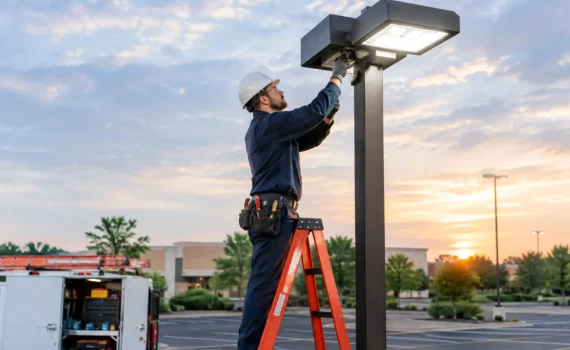
If the issue is limited to a component, the electrician may replace a failed LED driver, lamp, ballast, photocell, socket, wiring connection, or damaged lens. If a circuit has a fault, the repair may involve correcting damaged conductors, connections, breakers, or underground wiring. Pole-mounted lighting often requires proper access equipment, so the work can be completed safely without creating new damage.
A good service visit also includes checking the lights after repairs are complete. Controls should turn the fixtures on and off when intended, and repaired lights should match the operation of the rest of the lot as closely as practical. If the system uses photocells, timers, or a lighting contactor, they should be set up for dependable operation rather than temporary workarounds.
Repair or LED Retrofit?
For a newer LED fixture with one failed driver or photocell, repair is often sensible. It can restore service at a lower cost than replacing the entire fixture, especially when the housing, mounting, wiring, and light output are all in good shape.
Replacement becomes more attractive when fixtures are old, corroded, frequently failing, or no longer producing enough usable light. LED retrofits can reduce energy use and eliminate many lamp-and-ballast maintenance issues associated with older systems. They also turn on at full brightness and can provide a more consistent color across the property.
The decision depends on the number of problem fixtures, available replacement parts, utility costs, desired light levels, and the condition of the electrical infrastructure. Replacing one fixture in a small lot may be enough. For a larger property with multiple aging lights, a phased LED upgrade may make better financial sense than waiting for each fixture to fail.
Be careful about choosing fixtures based only on wattage or purchase price. Light distribution matters. A fixture that is too narrow may leave dark areas between poles, while one that is too bright or aimed incorrectly can create glare for drivers, neighbors, and nearby streets. A commercial electrician can help match the fixture and mounting height to the actual parking area.
Reduce Repeat Lighting Problems
Parking lot lighting does not need daily attention, but it should be reviewed regularly. Walk the property after dark every few months, not just when someone reports an outage. Look for dark sections, flickering fixtures, damaged poles, loose access panels, lights operating during daylight, and branches blocking the light path.
For properties with many fixtures, keep a simple record of repairs by pole number or location. This makes patterns easier to spot. If the same circuit, pole, or fixture type keeps failing, there may be a shared electrical issue worth correcting before it affects more of the lot.
Storms are another reason to inspect exterior lighting. A nearby lightning strike can damage drivers, photocells, and controls even if the lights appear normal at first. Water can also enter compromised fixtures after a hard rain. Calling for service early can prevent a small issue from turning into a broader outage.
Choose a Contractor Who Can Diagnose the Whole System
Parking lot lights connect to commercial electrical systems, often with high mounting locations, underground conductors, multiple controls, and equipment that has been modified over the years. The repair needs a licensed electrical contractor who can assess the fixture, circuit, control equipment, and panel rather than replacing parts until something works.
Property managers also need clear communication. Before work starts, you should understand what has failed, whether a repair or replacement is recommended, what access may be needed, and how the work will affect your property. For businesses that operate late, scheduling matters too. The right plan limits disruption while getting visibility restored as quickly as possible.
Beekman Electric provides commercial electrical repairs, LED retrofits, and parking lot lighting service with experienced technicians, straightforward recommendations, and free estimates for Katy-area property owners and managers. Whether one pole light has gone out or an aging lot needs a practical upgrade plan, a professional inspection provides a better answer than another temporary fix.
Do not wait until a customer, tenant, or employee has to walk through a dark section of the property to address a lighting issue. A timely repair helps keep your lot safer, more welcoming, and ready for the next evening’s traffic.